BRM-loading · layering pigment…
BRM-loading · layering pigment…
Two ways of answering one old question — where did we come from? One column holds the meaning-bearing stories humanity has told for millennia. The other holds what rock, bone, and clay tablet actually reveal. They run side by side, on purpose. Neither is collapsed into the other.
In tradition after tradition, the world begins in formless darkness, and order is drawn out of chaos — waters divided, light parted from night, a cosmos shaped and pronounced good. Genesis, the Vedic hymns of creation, and the Babylonian accounts all turn a void into a world by an act of will.
About 4.54 billion years ago, Earth gathered from the dust orbiting the young Sun. Countless collisions built a molten proto-planet; iron sank to form its core; a Mars-sized body struck it, and the thrown-off debris became the Moon. As the surface cooled, steam condensed into the first oceans.
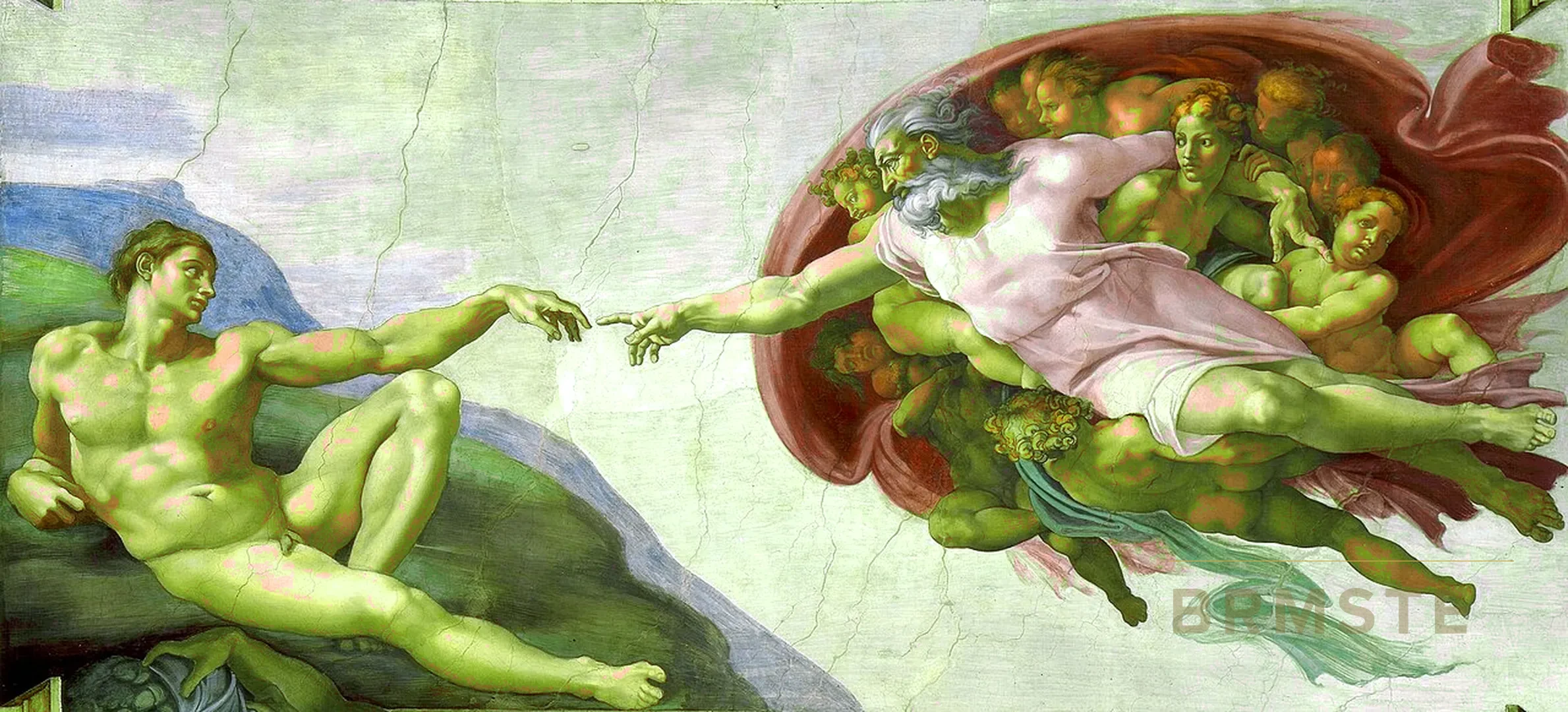
Humanity is shaped on purpose — formed from earth or clay and quickened with the breath of life, then named, given a garden, and held answerable. The very name Adam ties to adamah, the ground: the one drawn from the soil. It stands for a singular beginning and the sense of being set apart and accountable.
There was no single first human. Homo sapiens emerged gradually in Africa around 300,000 years ago, one branch of a long hominin lineage. Across tens of millennia came language, art, burial, and symbolic thought — the slow dawning of a mind that would one day ask where it came from.
Here the two columns lean closest and still don't merge: one tells of purpose and a singular origin, the other of gradual, population-level emergence. They answer different questions — meaning, and mechanism.
The impulse to exchange runs deep in our stories — gift and covenant, reciprocity and the marketplace. Cultures gave trade its own guardians, Hermes and Mercury among them, and wove honest exchange into law and ritual, treating the fair deal as something close to sacred.
Long before money, people moved what mattered: shell beads, red ochre, and obsidian carried hundreds of kilometres over 100,000 years ago. Farming and the first cities deepened it — and in Sumer, clay tokens for counting goods grew into the first writing. Trade became the nervous system binding strangers into a single human web.
These acts aren't three equal axioms feeding one machine. The Stage and The Web are written in evidence; The Spark is where a faith story and a fossil record meet without dissolving into each other. Held side by side, each keeps its own register of truth — one of meaning, one of measurement.
A respectful pairing, not an equivalence. Scientific dates carry their own uncertainties and are stated as best current estimates; the creation narratives are summarised across several traditions and are matters of faith, offered here for their meaning rather than as datable events.